
Anyone typing what is ICT into a search bar is usually trying to make sense of a term that shows up everywhere, from school curriculums to corporate job titles, yet rarely gets explained in plain language. ICT stands for Information and Communication Technology, and at its core it refers to the tools, systems, and networks that let people create, store, process, and share information electronically. That broad definition covers everything from the smartphone in your pocket to the massive data centers powering global businesses, which is exactly why the concept can feel confusing at first glance.
This guide breaks the topic down step by step, starting with a clear, no-nonsense definition before moving into how ICT actually works, where it shows up in daily life, and why it matters so much to modern economies and education systems. Readers will also find an honest look at the challenges that come with widespread ICT adoption, along with a forward-looking view of where the field is headed next. Whether the goal is academic research, professional curiosity, or simply wanting a straightforward answer, this article offers a complete and trustworthy reference point grounded in how the term is actually used by governments, educators, and technology professionals worldwide.
By the end, the phrase will no longer feel like vague technical jargon. Instead, readers should walk away with a practical understanding of the term, how it differs from related concepts like information technology, and how these tools quietly shape nearly every interaction with the digital world, from sending a text message to running a multinational supply chain.
What Is ICT: Breaking Down the Core Definition
To answer what is ICT in the simplest possible terms, think of it as an umbrella term covering any technology used to communicate and any technology used to manage information. This includes computers, the internet, mobile phones, software applications, television and radio broadcasting systems, and the networks that connect them all together. Rather than referring to a single device or piece of software, ICT describes an entire ecosystem of interconnected tools working together to move data from one place to another, often instantly and across vast distances.
The term deliberately combines two ideas that used to be treated separately: information technology, which focuses on storing and processing data, and communication technology, which focuses on transmitting that data between people or systems. When these two worlds merged, largely due to the rise of digital networks in the late twentieth century, the combined term ICT became the standard way to describe the resulting technology landscape. This is why international organizations, ministries of education, and technology policy documents almost always use ICT rather than IT alone when discussing digital infrastructure and connectivity.
It also helps to understand that ICT is not limited to cutting-edge innovations. Older technologies like telephones, fax machines, and even paper-based record systems are sometimes included in broader definitions, since the underlying goal, transmitting and managing information, remains the same regardless of how advanced the equipment is. This flexibility is part of why the term has remained useful for decades even as the specific tools it describes have changed dramatically.
The Building Blocks: Hardware, Software, and Networks Inside ICT
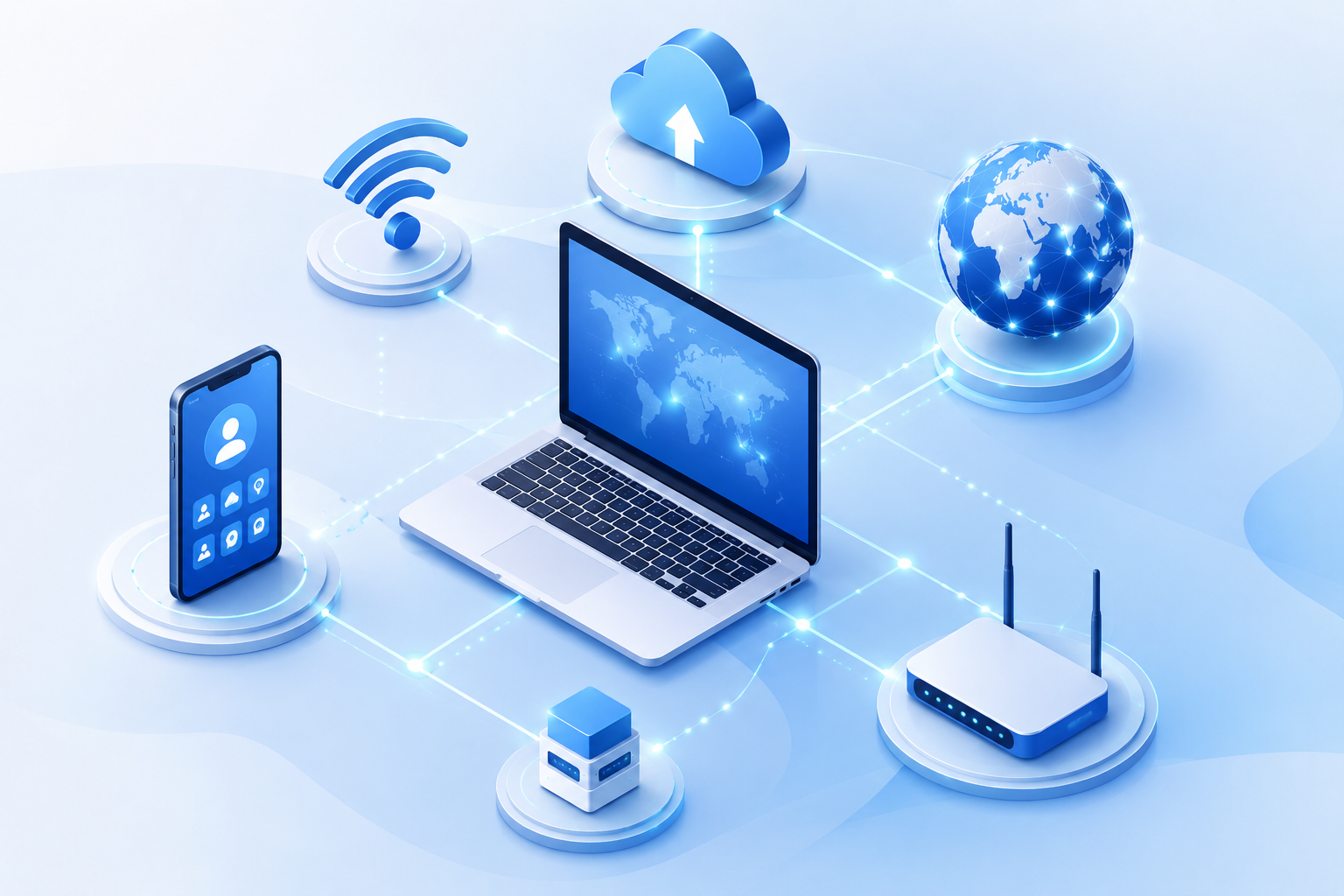
Every ICT system rests on three interconnected pillars, and understanding them makes the bigger picture much easier to grasp. Hardware refers to the physical equipment involved, including computers, servers, smartphones, routers, and the countless sensors and devices that now populate homes and workplaces. Without this physical layer, none of the digital processes people rely on every day would have anywhere to actually run, which is why hardware investment remains a foundational part of any organization’s technology strategy.
Software is the second pillar, and it includes the operating systems, applications, and programs that give hardware its purpose and functionality. A smartphone without an operating system is simply an inert piece of glass and metal, but layered with software it becomes capable of messaging, navigation, banking, and countless other tasks. Software development has become one of the fastest-growing areas within the broader technology industry, precisely because it determines how usable and valuable the underlying hardware actually becomes for everyday users.
The third pillar, networks, is what ties everything together and is arguably the piece that most distinguishes ICT from older forms of standalone computing. Networks include the internet, local area networks inside offices, cellular data networks, and satellite communication systems, all of which allow hardware and software running in different locations to exchange information in real time. Without reliable networking infrastructure, modern ICT as we understand it simply would not function, since the entire point of the field is connecting people and systems rather than isolating them.
A Brief History of How ICT Evolved Over Time
Understanding this field today is easier with some historical context, since it did not emerge overnight but rather evolved through several distinct waves of innovation. Early forms of information technology date back to the mid-twentieth century with the development of mainframe computers, which were massive, expensive machines used primarily by governments, universities, and large corporations for data processing tasks. Communication technology at the time remained largely separate, relying on telephone networks and radio broadcasting that had little direct connection to computing.
The real transformation began in the 1980s and 1990s, when personal computers became affordable enough for widespread adoption and the early internet started connecting these machines together across the globe. This convergence of computing and communication is precisely what gave rise to the combined term ICT, as organizations realized that information systems and communication networks could no longer be meaningfully discussed as separate categories. The rapid growth of email, websites, and early digital commerce during this period cemented the idea that technology’s value came from connection, not just computation.
The twenty-first century has continued this trajectory at an even faster pace, introducing smartphones, cloud computing, social media platforms, and increasingly sophisticated artificial intelligence tools into the ecosystem. Each of these innovations has expanded what the term encompasses, and educators and policymakers have had to continually update their definitions to keep pace with new technologies as they emerge and become mainstream parts of daily life.
Why ICT Matters in Everyday Life
It is easy to underestimate how deeply ICT is woven into daily routines until you try to imagine a day without it, from checking a weather app before leaving the house to using a mobile payment system at a grocery store checkout. These small, often unnoticed interactions represent the practical, everyday reality of this technology for most people, since the term ultimately describes tools that quietly support countless everyday decisions and tasks rather than existing as some abstract, distant concept confined to laboratories or corporate offices.
Beyond individual convenience, ICT plays a critical role in how communities stay informed and connected, particularly during emergencies when accurate, fast information sharing can genuinely save lives. Weather alert systems, emergency broadcast networks, and even simple text message notifications all depend on ICT infrastructure functioning reliably, which is why governments increasingly treat digital connectivity as essential public infrastructure rather than an optional convenience reserved for wealthier regions or populations.
The economic dimension is equally significant, since access to reliable ICT tools has become closely linked to opportunities for employment, education, and entrepreneurship. Small business owners can now reach global customers through online marketplaces, students can access course materials from anywhere with an internet connection, and remote work has become a viable career path for millions of people specifically because the underlying infrastructure has matured enough to support it reliably and affordably.
ICT in Education: Transforming How We Learn
Classrooms around the world have changed dramatically as a result of ICT adoption, moving well beyond chalkboards and printed textbooks toward interactive digital tools that support a wider range of learning styles. Interactive whiteboards, tablet-based learning applications, and online research databases have given students access to resources that previous generations simply could not imagine, often allowing lessons to be tailored more closely to individual pace and comprehension levels rather than following a rigid, one-size-fits-all approach.
Distance and online learning represent perhaps the most visible transformation within educational technology, particularly following the widespread adoption of video conferencing tools and learning management systems in recent years. Students in remote or underserved areas can now access courses, instructors, and educational communities that would have been geographically impossible to reach previously, a shift that has meaningfully expanded educational access even in regions with historically limited school infrastructure or specialist teaching staff.
Teachers have also benefited significantly, using these tools to streamline administrative tasks like grading and attendance tracking while gaining access to a much wider pool of instructional resources and professional development opportunities. That said, effective integration still requires proper training and reliable infrastructure, since simply placing devices in classrooms without adequate support or planning often fails to produce the learning improvements that well-implemented digital education strategies can genuinely deliver.
ICT in Business and the Modern Workplace
Modern businesses depend on ICT for nearly every core function, from communicating with customers and processing payments to managing supply chains and analyzing performance data. Enterprise software systems now handle tasks that once required entire departments of manual labor, allowing companies of all sizes to operate more efficiently while making faster, better-informed decisions based on real-time data rather than delayed quarterly reports or guesswork.
Cloud computing has been particularly transformative for businesses, allowing companies to access powerful computing resources without the enormous upfront cost of building and maintaining their own data centers. This shift has leveled the playing field considerably, giving small and mid-sized businesses access to the same sophisticated tools that were once available only to large corporations with substantial technology budgets and dedicated in-house engineering teams.
Remote and hybrid work arrangements, now common across countless industries, exist almost entirely because of mature digital infrastructure supporting video conferencing, cloud file sharing, and secure remote access to internal company systems. Understanding this technology in a business context therefore means recognizing it not as a single department’s responsibility, but as the connective infrastructure that touches marketing, finance, human resources, logistics, and virtually every other function within a modern organization.
ICT in Healthcare: Saving Lives Through Technology
Healthcare represents one of the most impactful applications of this technology, with electronic health records now allowing doctors and specialists across different facilities to instantly access a patient’s complete medical history rather than relying on paper files that could be lost, delayed, or incomplete. This kind of seamless information sharing has measurably improved diagnostic accuracy and reduced dangerous medical errors that once occurred simply because critical patient information was not available at the point of care.
Telemedicine has expanded access to healthcare for patients in rural or underserved areas, allowing them to consult with specialists remotely rather than traveling long distances for appointments that might otherwise be impossible to schedule locally. During periods of high demand on healthcare systems, telehealth platforms have proven especially valuable, allowing routine consultations to continue safely while reserving in-person visits for cases that genuinely require physical examination or intervention.
Beyond direct patient care, ICT also supports medical research, drug development, and public health monitoring through large-scale data analysis that would be impossible to perform manually. Hospitals increasingly rely on interconnected monitoring systems, diagnostic imaging software, and predictive analytics tools to identify potential health risks earlier, demonstrating just how far the practical applications of this technology extend beyond simple communication into genuinely life-saving territory.
ICT vs IT: Understanding the Key Differences
A common point of confusion when researching what is ICT involves distinguishing it from the closely related and often interchangeably used term information technology, or IT. While the two overlap significantly, IT traditionally refers more narrowly to the hardware, software, and systems used to store, retrieve, and process data within an organization, such as servers, databases, and business applications used internally by a company’s technical staff.
ICT, by contrast, deliberately emphasizes the communication component, including the networks, telecommunications infrastructure, and connectivity tools that allow information to move between people and systems rather than simply being stored and processed in isolation. This distinction matters most in policy, education, and international development contexts, where organizations specifically use the broader term to highlight the importance of connectivity and access, not just raw computing power sitting unused in a data center somewhere.
In practice, many professionals and organizations use the two terms loosely and interchangeably, and the overlap has only grown as internet connectivity has become a standard, expected feature of nearly every computing device and business system in existence. Still, understanding the historical distinction helps explain why certain industries, particularly education and international development, consistently favor the broader ICT terminology over the narrower IT label when describing their digital infrastructure priorities and initiatives.
Common Tools and Technologies That Fall Under ICT
The scope of tools considered part of this category is genuinely vast, ranging from everyday consumer devices to specialized enterprise systems that most people never directly interact with. On the consumer side, smartphones, laptops, tablets, smart home devices, and streaming platforms all qualify, since each relies on some combination of hardware, software, and network connectivity to function as intended for the end user.
On the enterprise and infrastructure side, the category expands to include servers, cloud computing platforms, enterprise resource planning software, customer relationship management systems, cybersecurity tools, and the vast telecommunications networks operated by internet service providers around the world. Even satellite systems used for global positioning, weather forecasting, and remote internet access technically fall under this umbrella, since they contribute directly to how information is gathered, processed, and shared across long distances.
Social media platforms, messaging applications, video conferencing software, and collaborative document tools also belong firmly within this category, representing some of the most visible and frequently used forms of ICT in daily personal and professional life. Recognizing just how many familiar tools fall under this single umbrella term helps illustrate why this concept genuinely touches nearly every digital interaction people have throughout an ordinary day.
Challenges and Risks Associated with ICT
Despite its many benefits, widespread ICT adoption has introduced genuine challenges that deserve honest acknowledgment rather than being glossed over in favor of purely positive messaging. Cybersecurity threats have grown increasingly sophisticated as more sensitive personal and financial information moves through digital networks, making data breaches, phishing attacks, and ransomware serious concerns for individuals, businesses, and government agencies alike, regardless of size or industry.
The digital divide represents another significant challenge, referring to the gap between populations with reliable access to modern technology infrastructure and those without it, often due to geographic isolation, limited financial resources, or insufficient investment in local telecommunications infrastructure. This divide can reinforce existing social and economic inequalities, since access to reliable internet connectivity increasingly determines opportunities for education, employment, and participation in modern civic and economic life.
Privacy concerns have also intensified alongside this expansion, as the same tools that enable convenient communication and data sharing also create opportunities for surveillance, data misuse, and unauthorized tracking of personal information. Addressing these challenges requires ongoing collaboration between technology companies, governments, and civil society organizations, since no single group can realistically solve issues as complex and far-reaching as global cybersecurity and equitable digital access on its own.
Digital wellbeing has become a related concern worth mentioning, as constant connectivity through smartphones, social media, and messaging applications has raised legitimate questions about screen time, attention spans, and mental health, particularly among younger users who have grown up fully immersed in these tools. Schools, parents, and health professionals increasingly encourage intentional, balanced technology use rather than outright avoidance, recognizing that these tools are not going away but do require thoughtful habits to use well.
The Future of ICT: Emerging Trends to Watch
Looking ahead, several emerging trends are set to reshape how people understand and interact with information and communication technology in the coming years, building on the rapid innovation already reshaping the field. Artificial intelligence and machine learning are increasingly embedded within everyday tools, powering everything from personalized content recommendations to automated customer service systems that can handle increasingly complex conversations without direct human involvement.
The continued rollout of faster wireless networks is expanding what is possible with mobile and remote connectivity, supporting innovations like real-time remote surgery assistance, more responsive smart city infrastructure, and increasingly capable autonomous vehicle systems that depend on near-instantaneous data transmission to function safely. As these networks mature and expand into currently underserved regions, the digital divide discussed earlier may gradually narrow, though meaningful progress will require sustained investment and deliberate policy attention rather than happening automatically.
Sustainability is also becoming a bigger consideration within this space, as data centers and telecommunications infrastructure consume significant amounts of energy worldwide. Technology companies are increasingly investing in renewable energy sources and more efficient hardware designs to reduce the environmental footprint of the digital infrastructure that modern life increasingly depends on, recognizing that long-term growth in this sector must be balanced against genuine environmental responsibility.
The Internet of Things, referring to the growing network of everyday physical objects embedded with sensors and connectivity, from thermostats to industrial equipment, is also expected to expand significantly, generating enormous volumes of data that businesses and governments can use to make more informed decisions. As more of the physical world becomes digitally connected in this way, questions about data ownership, security, and interoperability between different devices and platforms will likely become increasingly important topics for policymakers and consumers alike to navigate together.
ICT Skills and Career Opportunities Worth Knowing About
The rapid expansion of digital tools across nearly every industry has created enormous demand for professionals who understand how to build, maintain, and secure these systems. Careers in this space range widely, from software developers and network administrators to cybersecurity analysts, data scientists, and user experience designers, each contributing a different piece to the overall technology ecosystem that businesses and governments now depend on daily. Many of these roles did not exist in their current form even two decades ago, reflecting just how quickly the underlying skill requirements continue to shift.
Educational institutions have responded by expanding computer science and digital literacy programs at every level, from introductory coding classes in primary schools to specialized graduate degrees in fields like artificial intelligence and cybersecurity. Beyond formal degrees, many professionals now enter the field through certification programs, coding bootcamps, and self-directed online learning, reflecting how accessible foundational technology education has become compared to previous generations who often needed expensive, lengthy university programs to break into the industry.
Basic digital literacy has also become an expected skill well beyond dedicated technology careers, since nearly every modern job now requires some comfort with email, spreadsheets, video conferencing, or industry-specific software platforms. Employers increasingly view foundational digital skills as a baseline expectation rather than a specialized bonus, which is part of why many workforce development programs now prioritize practical technology training alongside traditional academic subjects.
Salary and demand trends across the sector also continue to reward candidates who combine technical skills with strong communication and problem-solving abilities, since most technology roles now involve close collaboration with non-technical colleagues, clients, or customers rather than working in isolation. Professionals who can translate complex technical concepts into clear, accessible language for a broader audience often find themselves particularly well positioned for leadership roles as they advance further into their careers, since bridging that communication gap has become just as valuable as raw technical expertise in many organizations.
How Governments and Organizations Support ICT Development
Because reliable technology infrastructure has become so closely tied to economic growth and educational opportunity, many national governments have made expanding access a formal policy priority backed by dedicated funding and legislation. Public investment often targets expanding broadband internet access into rural and underserved communities, subsidizing computer equipment for schools, and funding digital literacy training programs aimed at populations who might otherwise be left behind as services increasingly move online.
International organizations play a significant supporting role as well, with groups like the United Nations and various regional development banks funding infrastructure projects specifically designed to close global connectivity gaps, particularly across developing regions where reliable internet access remains far less common than in wealthier nations. These efforts are often framed around the idea that meaningful participation in the modern economy increasingly requires reliable digital access, making infrastructure investment a matter of economic opportunity rather than simple convenience.
Private companies also contribute meaningfully through infrastructure investment, corporate social responsibility programs, and partnerships with schools and nonprofit organizations aimed at improving digital access and literacy. Telecommunications companies, in particular, frequently collaborate with local governments to extend network coverage into areas that might not otherwise be commercially attractive to serve, recognizing that expanded connectivity ultimately grows their own long-term customer base while also delivering genuine public benefit.
Policy debates in this area often center on questions of regulation, competition, and affordability, since expanding physical infrastructure alone does not guarantee that households will actually be able to afford reliable service once it becomes available. Some regions have experimented with subsidized internet plans for low-income households, public Wi-Fi initiatives in libraries and community centers, and device lending programs, each representing a different approach to ensuring that infrastructure investment translates into genuine, usable access rather than existing only on paper.
Conclusion
Understanding what is ICT ultimately comes down to recognizing it as the combined technology and infrastructure that allows information to be created, processed, stored, and shared across networks connecting people and systems worldwide. From the smartphone notifications interrupting a morning commute to the complex hospital systems tracking patient care, this technology touches nearly every corner of modern life in ways that are often invisible precisely because they work so reliably and consistently in the background.
This guide has walked through the core definition, historical development, practical applications across education, business, and healthcare, along with the genuine challenges and promising future developments shaping the field. Armed with this fuller picture, readers should now feel confident explaining not just what ICT stands for, but why it has become such a fundamental part of how modern societies function, communicate, and continue to grow more connected with each passing year.
FAQs
What is ICT and what does the acronym stand for?
ICT stands for Information and Communication Technology, a broad term describing the combined tools, systems, and networks used to create, store, process, and share information electronically, including computers, the internet, mobile devices, and telecommunications infrastructure.
What is the difference between ICT and IT?
IT typically refers more narrowly to hardware, software, and systems used to store and process data, while ICT specifically emphasizes the communication and networking component that allows information to move between people and systems, though the two terms are often used interchangeably in practice.
Why is ICT important in education?
It supports education by giving students access to digital learning resources, interactive tools, and online courses that expand access beyond traditional classroom limitations, while also helping teachers streamline administrative tasks and access broader professional development opportunities.
What are some common examples of ICT tools?
Common examples include smartphones, laptops, the internet, email, video conferencing software, cloud computing platforms, social media applications, and enterprise systems used for business management, all of which rely on hardware, software, and network connectivity working together.
How does ICT impact modern business operations?
It enables businesses to communicate with customers, process payments, manage supply chains, analyze performance data, and support remote work arrangements, making it a foundational part of nearly every business function rather than a separate, isolated department.
What challenges come with widespread ICT use? Major challenges include cybersecurity threats, the digital divide between populations with and without reliable internet access, and privacy concerns related to how personal data is collected, stored, and potentially misused across increasingly interconnected digital systems.
What does the future of ICT look like? The future includes deeper integration of artificial intelligence, faster wireless networks supporting real-time applications, and growing attention to sustainability as data centers and telecommunications infrastructure work to reduce their overall environmental impact.